martes, 22 de diciembre de 2015

Blatter’s FIFA ban comes as vindication for Luis Suárez’s mistreatment


   Back in the years of the trials against World War II criminals, the German-born Jewish thinker Hannah Arendt used to point out that due punishment was central to satisfying the victims’ claims for justice. Not only was it essential in terms of reparation and rule of law, due punishment also gave the punishing authority legitimacy in the eyes of those concerned: it’s as much an act against impunity as it’s a defense of the rights of the victims. She wrote:
[I]n view of the current confusion in legal circles about the meaning and usefulness of punishment, I was glad that the judgment quoted Grotius, who, for his part, citing an older author, explained that punishment is necessary "to defend the honor or the authority of him who was hurt by the offence so that the failure to punish may not cause his degradation."
Up until his arrival to FC Barcelona, Luis Suárez had been a test to rivals, referees, pundits, officials and pretty much all of us when it came to our notions of how much punishment is due and fair for a constant and seemingly unrepentant offender. The English FA had the Uruguayan striker banned for months of competition after finding he had used the Spanish word “negro” against Patrice Evra. A season or so later, the same body banned him again for biting Branislav Ivanovic during a set-piece in which the Chelsea man had been holding and pulling Suárez. Despite the fact that both verbal abuse and violent conduct are offenses which should be prosecuted by the referee as they occur (by booking or sending off), in neither episode was Suárez shown a red card. Instead, he was retrospectively prosecuted and punished.

Suárez’s misdeeds would have remained in the Premier League annals had it not been for another episode of biting in the vital match between Italy and Uruguay in the 2014 World Cup. The Ivanovic pattern was repeated now with Giorgio Chiellini: a set piece to be kicked, a defender holding a forward in the box, the forward gets alienated and finally bites his rival’s shoulder. The offense, again, went unnoticed by the referee despite the Italian desperately showing him the teeth-marks over his skin. Uruguay thus could kick Italy out of the competition with eleven men when the interests of justice were to have the South Americans trailing with just ten players. As the images went viral immediately, and pundits and fans were inflamed and bloodthirsty for “an exemplary punishment”, FIFA applied law retrospectively and handed out Suárez a lengthy ban that is going to be completed only in next February when Uruguay resumes World Cup qualifiers.

“An exemplary punishment” devised to learn Suárez a lesson he won’t forget, that FIFA ominous ban did little and nothing to prevent terrible aggressions from happening again. Due punishment must also be an instrument to inhibit misconducts on the field. And the case of Suárez sadly was and will be just one of witch-hunting when far worse infractions (like Arda Turan throwing his boot against a linesman, or Felipe Melo trying to behead Lucas Biglia with a karate kick) are prosecuted as “average” or aren’t prosecuted at all. Witch-hunting, the exact opposite of due punishment, undermines the legitimacy of the punishing authority and neglects calls for justice from those offended on a pitch. The many retrospective bans the Suárez disciplinary file may still accumulate over the years will not preclude the Turans or the Melos from offending again in the future.


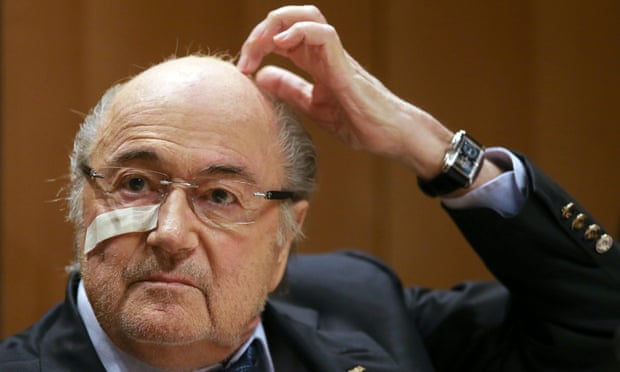
Sepp Blatter, the acting president of FIFA when Suárez was punished, has now received an eight-year ban from soccer-related activities.  Ruling out the charge of corruption (to wit: that Blatter enriched himself using his post at FIFA), the Ethics Committee found him guilty of offering gifts to Michel Platini and of conflict of interest as the Swiss was unable to demonstrate that the 2 million Swiss francs payment to the UEFA suspended president had some legal basis. Without a more detailed, well-sustained and far-reaching verdict from the Ethics Committee, however, the impression is that FIFA built its probe against Blatter merely on the criminal investigations of the Swiss authorities and therefore this body is one more time witch-hunting rather than executing due punishment.

Blatter’s ban of course comes as vindication for Luis Suárez’s mistreatment. It tells us unequivocally that whoever uses the FIFA infernal political machine to witch-hunt is prone to being witch-hunted himself. Perhaps Suárez’s wishes for a fair treatment are now satisfied (in a quite narrow sense) when he sees an otherwise fat cat being given a ban similar to that which he still has. But the worst practices presided over by Blatter during his long tenure, vote-buying, suspicions of electoral fraud and forgery, were neither investigated nor punished by the Ethics Committee. And that’s truly a source of concern since the witch is now gone but witchcraft still is here.

lunes, 7 de diciembre de 2015

Timbers' glory proves what MLS dearly needs

Land in the massive names from the European game to enlarge the fan base, make the league more profitable. Feed back the virtuous cycle. The 20th season of Major League Soccer began some months ago with those words as the compelling mantra everywhere: Kaka, David Villa, Andrea Pirlo, Giovani Dos Santos and Sebastian Giovinco -amongst others- were destined to be the absolute stars of this watershed year.

Instead, the show was stolen by unsung heroes such as Nat Borchers, Kei Kamara, Mauro Díaz or Sacha Kljestan. Both conference finals were devoid of those flamboyant signings, and yet, they were -for the first time perhaps- plenty of tactical features and astute game management that allowed for some moments of exciting uncertainty. Unlike the preceding season's MLS Cup final between LA Galaxy and New England Revolution in which both squads played similarly and produced a midfield gridlock that was only broken in extra time, the road to Columbus Crew versus Portland Timbers allowed for last-minute goals, penalty shootouts definitions, record-breaking early goals and chalkboard lessons on how to manage a lead.

That Galaxy-Revolution final was a good illustration of what MLS matches still are to a extent: players get into the pitch primarily focused on producing a lead and on avoiding concessions. Being concerned on that, nevertheless, many teams often neglect flux-of-play management considerations which are those that precisely allow to control the tempo: speed-up and slow-down, the ability to change the script. Playing the standardized formation with a four-men defensive line plus a holding midfield duo (either in a 4-4-2 or a 4-2-3-1), the typical MLS side would seat deep and soak pressure up by means of two banks of four as the only way to conserve a lead. Thus, matches like that Galaxy-Revolution final would become about individual brilliance more than anything else, and MLS would want to sign stars rather than build proper teams.

The Columbus Crew-Portland Timbers final proved opposite to its predecessor. The home side was clearly playing a well-drilled standard formation in which Kei Kamara benefitted from Greg Berhalter's focus on play through the channels in order to feed him as classic target man, while the away side opted for an unorthodox 4-3-3, ruthless at high-pressing. Although it was Crew the side that consistently took early leads launching long balls and winning aerial duels (against both Montreal Impact and NY Red Bulls), here the Timbers broke all the records by pressurizing the opposition's build-up play straight away from the initial whistle. After that -and just like against Vancouver Whitecaps- Portland set the tempo of the match and their lead was hardly disputed throughout.

The Timbers could execute their strategy of high pressure since the key feature of a 4-3-3 is the lone holding midfielder flanked by two shuttlers at either side. Diego Valeri and Darlington Nagbe were freer to motor forward because Diego Chará did a brilliant job closing passing lanes with pure positional awareness. That is, the Colombian man had to "read" when to move up so gaps weren't opened between the lines as the shuttlers went up in the field: had those "readings" been inaccurate or slow, Chará would have risked a bigger influence from Federico Higuaín and a possible Columbus comeback. These heatmaps suggest the entirely different approaches between the Crew holding midfield duo -Will Trapp and Tony Tchani- and Timbers' three men midfield. Note as well the number of touches (more men in midfield, more space covered, more dynamism, more midfield domination):


Chará is probably the best lone holding midfielder in MLS since the good days of Kyle Beckerman with Real Salt Like. His solid performances gave Caleb Porter a good argument for high pressure, harnessing on the work-rates of Valeri and Nagbe. None of these three midfielders, moreover, were landed in MLS as the superstars the mantra says are prerequisite to enlarge the fan base. Big names of course attract attention for a while, but team-building ensures competitiveness and sustainability. These playoffs have proved that it's teams and not individuals who get past rounds and lift trophies. Timbers' glory proves what MLS, now, dearly needs.

miércoles, 25 de noviembre de 2015

What is Miguel Layún's best flank on the pitch?


In view of the goal-scoring tally Miguel Layún had with Porto departing from the left towards his natural and strong right foot against Maccabi Tel Aviv and Vitoria Setubal, all talk about putting him back to the right flank seemed nonsense. Having him playing inverted, the argument says, adds an important offensive threat by enabling Layun to cut inside and try from long range or even reach goal-line, check back, and cross immediately: the Porto experience was doubtlessly demonstrating so.

Let us recall Layún's conversion from average right winger towards outstanding left wing-back for Club América. After a short-lived journey in Serie A with Atalanta, he returned to Mexico and endured personal tough times when people tweeted constantly #TodoesculpadeLayún (#BlameitallonLayun), until the arrival of Miguel Herrera. Herrera had brought solid Adrián Aldrete to play left wing-back for main league competition while handing to Layún the Copa Mx minutes. Playing the cup, Layún managed to score screamers outside the box departing from the left and also learned slowly to use his left foot to launch more or less acceptable crosses. By the summer of 2013, Layún had claimed for himself Aldrete's starting spot and begun his assault on the national team for the World Cup.

Layún's offensive contribution from the left in Brazil 2014 was nonetheless poor. His military discipline and endless energy helped Mexico to remain compact and cohesive versus top opposition at the biggest stage, but it was all about defending. A good explanation of the rise of Layún is that he was in fact part of a global trend of inverted wingers and inverted full-backs. Attacking wingers drifting inside not only enabled them to find space and reach for target with their strong natural foot, it also enabled the full-backs to make overlapping runs and add unpredictability, penetration and width (a classic example of this was pre-Guardiola Bayern Munich: Robben would cut towards his left foot from the right flank while Lahm would surge and cross with his natural right foot). Hence, a tactical development to counter inverted attacking wingers was to place inverted full-backs as well, able to deal with dribblers with their strong foot (Spanish right-footed full-back César Azpilicueta claiming Ashley Cole's starting spot on the left for Chelsea remains a great antecedent for this Layún-esque development). In this light, the deployment of Layún on the left flank of the full-back spot was always a defensive resource against stronger sides which sometimes -and only sometimes- went offensive against weaker ones.

It took the challenge of an old-school right-footed winger to test Layún's defending on the left for Champions League level. Dynamo Kyiv's victory in Do Dragão was as much about undoing Porto in the middle as about exposing full-backs Maxi Pereira and Layún in the channels. While Pereira dealt with Paraguayan inverted winger Derlis González, the Mexican man dealt with Ukrainian Andriy Yarmolenko. Barring the penalty kick that Yarmolenko himself scored, his continuous runs towards goal-line on his right foot produced the best chances in the first half that made the away side fully deserving of their lead. Layún was powerless.

For the second half, the Porto boss Julen Lopetegui took Pereira (number 2) off, moved Layún (number 21 encircled in yellow) to the right, and placed central defender Bruno Martins Indi (number 3) to the left full-back spot in order to deal with Yarmolenko. Lopetegui's improvisation did not work either since Derlis González found even more space between Danilo and Layún to increase Dynamo's lead to 2-0 (graphic taken from UEFA's full-time tactical lineups).

What is thus Miguel Layún's best flank on the pitch? He has proven such a versatile, functional and fast-learning footballer that the actual answer is: it depends. It depends on whether his team plays with possession or plays at the counterattack, on whether he should overlap upfront or should stay tight at the back, whether he faces inverted wingers or natural ones. Noteworthy is also the fact that Layún himself playing for Watford was placed advanced on the field by Quique Sánchez-Flores in the inverted winger spot; there, Layún cut inside while left natural full-back José Holebas overlapped. The goal he scored against Everton at Goodison Park in the first match of the Premier League demonstrated so: it added an offensive threat without compromising defensive cohesion.

Layún is truly a man for all seasons. Not only does his football accept questions of left or right, but also questions of defense and attack, width and depth.

miércoles, 18 de noviembre de 2015

Honduras 0-2 México: Osorio outfoxes Pinto

  Call it lackluster and dull, but every analysis of the Mexico victory in Honduras should take into account the astute tactician seated in the other bench. By the implementation of strategies and tactics which appeared counterintuitive, Jorge Luis Pinto outfoxed all of his peers between 2013 and 2014 at the helm of Costa Rica. One good example of this was his use of a three-men defensive line: the tactical textbook says a third central defender becomes redundant when playing against a lone striker formation and thus becomes one player less in midfield.

Well, during the World Cup the man stuck to his plan and his success even forced Italy and Uruguay to play Pinto's tactics facing each other to claim the last berth to the last 16 after Costa Rica's early qualification. A recall of that match's tactics by Michael Cox might help us at understanding why El Tri's show in San Pedro Sula made a great deal of Mexican fans fall asleep:

You can’t judge any match purely – or even primarily by formations alone. But if there’s one formation match-up that should be avoided at all costs, it might be 3-5-2 against 3-5-2. It tends to produce slow, frustrating matches with neither side capable of finding space in the opposition half – both sides have a spare man at the back, the wing-backs run up and down the line with one another all game so there’s no outlet on the flanks, and the midfields tend to cancel each other out.
In other words Mexico and Honduras were playing the same formations. Those might have been 3-5-2 against 3-5-2 making the boredom Cox notes, or 3-4-3 against 3-4-3 (evidence suggests this latter was the precise case here), but the fundamentals remain the same: it was a squad matching up another squad on a football field and vice versa. Miguel Layún knew he had to cover Emilio Izaguirre, Hugo Ayala knew he was there for Érick Andino, Héctor Moreno knew his man was Mario Martínez and so on. At times, both teams were actually man-marking instead of zonal-marking and that became fatally evident within the open angle that captured the whole pitch in the build-up towards Garrido's devastating knee injury:


Honduras playing with three center backs like Mexico, Oswaldo Alanís makes a decoy run on the left wing to lure Wilmer Crisanto on him and open space for Javier Aquino to pick the ball, Aquino does so and gets past his man-mark (Johnny Palacios); Crisanto suddenly realizes a central defender has get caught up in the field and runs frantically to tackle Aquino and stop him. Crisanto gets Aquino down and involuntarily injures his teammate. In the frame, one even can see Mexico and Honduras playing 2014 Costa Rica tactics: Javier Hernández is alone in front of three defenders like the Honduras nine, Rubilio Castillo, in front of three Mexicans.

Juan Carlos Osorio was clearly deploying attrition warfare against Jorge Luis Pinto. In a game of equal formations and man-marking, the side better prepared physically and with more individual quality usually beats the side less prepared and with less talent. Pinto, strategically speaking, used to beat bigger sides (Uruguay, England, Italy) harnessing on their need to get past a lesser side, but Osorio here outfoxed him harnessing on Honduras' need to get the three points after their loss to Canada.
  
In spite of Osorio appearing now as a boring and gray man in the eyes of many, his first away victory in Concacaf proves him a coach that does study his bench rivals no matter how humble the opposition might appear.

sábado, 14 de noviembre de 2015

Argentina 1-1 Brazil: Dunga beats Martino

Such was the intense play that broke lines at peaks during the first clash between Argentina and Brazil for World Cup qualifiers, that one is left wondering whether the insipid countless friendlies that take South America's ultimate derby elsewhere across the globe taint the quintessence of the rivalry. In what is dramatically becoming the watermark of Gerardo Martino's tenure, Argentina indulged in its raw talent (even without Messi) producing vibrant counter-attacking football which must have created a bigger lead than 1-0, only to fade near to collapse when Dunga introduced Douglas Costa, Brazil equalized, and must have got the three points from Buenos Aires before David Luiz's red card.

Both managers used roughly the same formation, 4-2-3-1. Mystifyingly enough, Dunga resorted to Brasileirao names in key spots with mixed results: Santos FC's reborn Ricardo Oliveira and Lucas Lima were picked ahead of Costa himself and Oscar, thus meaning Neymar was deployed in the very same channel occupied by Ángel Di María. Barring some sparks from both, however, their contribution was rather scant in spite of the fact that having the two superstars on the same side of the field implies a gamble that was barely tested throughout. It was people like Willian, Dani Alves, Ever Banega or the Argentina central defenders -Funes Mori and Otamendi- who were most willing to ride their luck over the slippery turf.

A game of identical formations means identical duties and identical liberties. The full-backs (Alves, Filipe Luis, Roncaglia and Rojo) should cover the wingers (Willian, Neymar, Di María and Lavezzi) and the wingers should track back the full-backs. For this case, the free men were located in the holding midfield and in that number ten spot behind the lone striker. That is, the nominally free in either side were Lucas Lima and Éver Banega; the dominance of Argentina in the first stages of the match is thus explained by Banega's ample expertise over young and still untested Lucas Lima. While this latter made way more passes than the former, the bulk of his passes were backwards as the Sevilla FC man dropped deep and launched incisive through-balls to the front. Argentina's goal came after Banega cleared the ball from deep towards Di María forcing Luiz Gustavo out of the center and opening space for Lavezzi's run.


Lima, on the other hand, remained as isolated as Ricardo Oliveira upfront and this appeared explicitly instructed by Dunga, for this "immobility" was the key factor for Brazil's equalizer when Lima caught a rebound from the bar following a Costa's header inside the Argentine box. Had Lima dropped deep like Banega the whole match, he wouldn't have been fresh enough to be in the right place at the right time. The Canarinha rallied back and Neymar got activated attempting target twice within Argentine chaos. In that moment, Dunga subbed Lima off for Renato Augusto and modified from 4-2-3-1 to the 4-3-3 Corinthians normally use (with the same shuttlers: Elias and Augusto) in order to slow down the tempo and control the midfield.

Martino perhaps realized that he had awaited far too much for refreshing his side when he made a late double substitution (Paulo Dybala and Erick Lamela on for Higuaín and Banega). Having too little time to introduce a new tactical plan, the only two sources of hope for Argentina to get the first victory were set-pieces and David Luiz being sent-off for reckless tackles. Although this was a fair draw, Dunga departs reinforced from Buenos Aires and Martino is now more weakened than ever. 

The Argentine boss now heads to Colombia in a match that promises deep emotions and dire consequences for hosts and guests.

jueves, 5 de noviembre de 2015

The amazing proliferation of playmakers in MLS


The one and only feature that shocked most during the first-leg clash between Seattle Sounders and FC Dallas was the presence of a clear-cut pattern in almost every goal threat. Whether it was Mauro Diaz spraying accurate through balls towards the channels worked by the Colombian speedy pair of Michael Barrios and Fabián Castillo -even unlocking Seattle's defense towards David Texeira-, or Andreas Ivanschitz getting past Cirigliano for the home side's eventual equalizer, the evidence is conclusive: traditional number tens surprisingly thrive in Major League Soccer.

Long thought as an obsolete interpretation of the position -mostly in Europe-, the old-school playmaker, enganche or trequartista, as it's called in Argentina and Italy, for all of his technical virtue, guile and flair, demands constant movement and pace by his forwards, shuttlers and full-backs. This player became endangered in the European game since it usually implies the deployment of two strikers that, by themselves, should provide the attacking width: which is fine in offensive phases, but becomes problematic at defending against wide formations such as, say, standard 4-4-2. Thus, classic tens like Francesco Totti or Luka Modric found place either as "false nines" (that is, an strikerless formation for possession-oriented sides), or as holding midfielders (deeper, they face less pressure, the argument goes).

Part of the above point also applies to our case-study playmakers: Diaz and Ivanschitz. In the first case, the Argentine occupied the number ten role in a modern 4-2-3-1 that has become default formation everywhere insofar as the wingers - for this specific, Barrios and Castillo- are willing and disciplined to track back and form two banks of four that make life impossible for the opposition. The downside of this approach is that it puts a considerable work load on the wingers' legs, exhausts them and risks losing cohesion (which actually happened when Sounders staged the 2-1 comeback). During the first stages of the match, however, Mauro Diaz and the Colombians were stealing the show and FC Dallas should have taken a bigger lead. Ivanschitz, on the other hand, was placed by Sigi Schmid on the left wing in an otherwise crystal-clear 4-4-2. There, the Austrian charged towards the center making overloads and helping Seattle to retain possession (Dempsey and Martins provided width).

Ivanschitz's equalizer is most illustrative the way playmakers operate in MLS. The Austrian overloaded the midfield (three men from Sounders, holding midfielders plus Ivanschitz against Ulloa and Cirigliano from FC Dallas), received the ball, beat Cirigliano and -astonishingly- found oceans of empty space in the spot that should have been covered by Jamaica full-back JV Watson. Ivanschitz pulled the trigger and netted home past Jesse González. What Ivanschitz did with his interior movement, tactically speaking, is a gamble: invites his full-back to make overlapping runs but entices Watson to do the same and leave a massive void in FC Dallas' defense. Sometimes it works, sometimes it backfires.


The underlying reason for the proliferation of old-fashioned playmakers is that MLS full-backs more often than not get caught too up in the pitch. Reading a piece on Borussia Dortmund's new boss Thomas Tuchel (who had Ivanschitz at Mainz in Bundesliga), one discovers that his predilection for playmakers (now he uses Shinji Kagawa) actually lies in the German trend of pressing relentlessly the opposition build-up play: the number ten harries the holding midfielder to force him to lose possession and produce an instant goal opportunity. An alternative to counter this kind of pressing is using a three-men defensive line that transforms full-backs into wing-backs and covers for their overlapping runs. It's fair to say that it's matter of time to the number ten's proliferation in MLS to provoke tactical developments similar to other leagues everywhere else.

Until we reach that point, nonetheless, virtuous playmakers like Michael Bradley or Nacho Piatti too will remain a huge attractive for a league that, for now, resembles something of a lost paradise.

miércoles, 14 de octubre de 2015

Uruguay 3-0 Colombia: Tabárez's solutions, Pékerman's troubles


 The decision-making of Óscar Tabárez and Néstor Pékerman in Uruguay and Colombia can't be more dissimilar now: the former copes with the absence of his world class Cavani-Suárez striker partnership due to suspension, while the latter enjoys such a deep pool of talent in quest for a way to fit it all within the same squad. The Montevideo clash showed a Uruguay of no glare, but cohesive and ruthless, and a Colombia of glare, but too imbalanced and fragile.

Although the Colombia boss didn't have James Rodríguez, he used instead decent playmaker Edwin Cardona from the start and later in the second half introduced another ball-playing midfielder in MacNelly Torres without subbing Cardona. Indeed, the use of Freddy Guarín shuttling to the right of holding midfielder Carlos Sánchez was reminiscent of the midfield diamond used by Roberto Mancini at Internazionale with Guarín in the very same role. Juan Guillermo Cuadrado, however, began the match wide on the left wing flanking Cardona and thus it was an unorthodox (and tipped) formation. Cuadrado's spot on the left, being right-footed himself, raised controversy amongst Colombian twitters, but Colombia's underperformance first and foremost was about tactical imbalance and just then about individual performances.


The image that heads this story is eloquent: whereas left full-back Frank Fabra is well protected by Cuadrado's tracking back, right full-back Santiago Arias is alone in front of oceans of space with no winger to double protect his channel. It only took some audacity by Uruguay's full-back Álvaro Pereira (as Martín Cáceres was early replaced through injury) to gain the bottom line and cross or provoke set pieces. All in all, Pékerman was justified to deploy two numbers nine - Bacca and Teo- with a complete platoon of creative players behind them as long as he surely expected Uruguay to seat deep with two banks of four and soak pressure up with 0-0 still on the score. Colombia's tactical imbalance became an issue when Uruguay took the lead via a Godín power header and thus Colombia had to chase the match. The home side sat deeper and exploited the wings yet again for the successive goals as Carlos Sánchez and Guarín were clearly outnumbered at covering the the pitch to the right. Teo should have tracked back, but he's proven great at running horizontally, not vertically.

The new troubles of Pékerman with Colombia seem rooted in his persistence on playing the whole offensive arsenal at expense of balance and width. The Copa América elimination to Argentina a few months ago was a similar match to this one in Montevideo: Pékerman fields a lone holding midfielder -that time it was Alexander Mejía- who clearly gets outnumbered by default formations such as 4-4-2 or 4-2-3-1/4-3-3. Against Argentina, his squad bled in the center of the pitch; with Uruguay, it bled over the flanks (see heatmap).


The old solutions of Tabárez with Uruguay, as usual, seem rooted in the boss's recognitions of where Uruguay as a team has world class talent and where it has just decent players. It's noteworthy, however, that both Suárez and Cavani were absent and anyway the block remained cohesive and well organized. One is even tempted to say that, had Uruguay played a strikerless formation of 4-4-0,  they anyway would have relied on set pieces to score and on their two banks of four to maintain their lead and alienate the opposition. Formation and strategy permit the return of both strikers with the minimal previous work allowed by international football.

The Montevideo match between Uruguay and Colombia gives credence to South American qualifiers' reputation as the toughest of all. For they demand quick solutions and punish dearly those who get into tactical troubles.